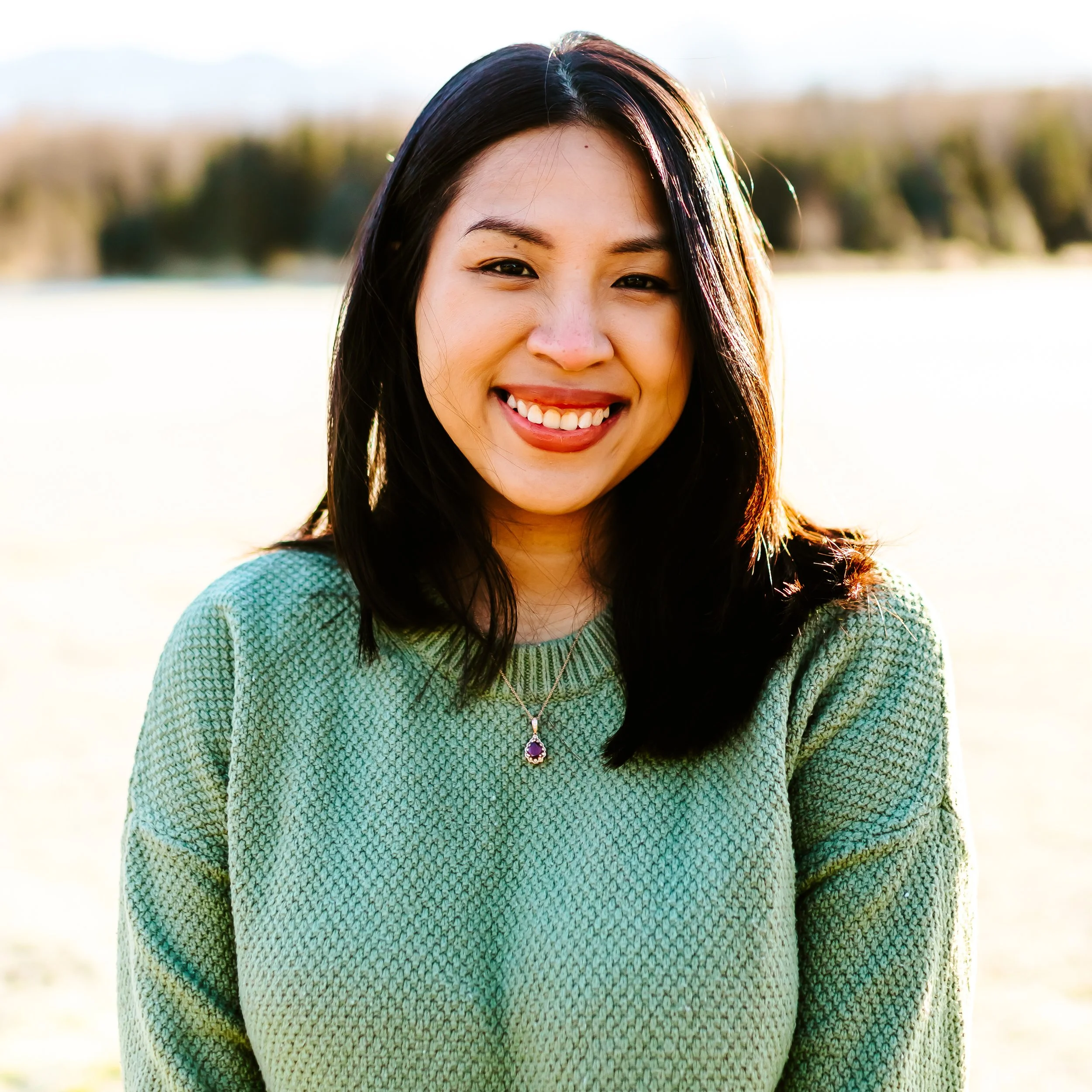
Vicky and Danny Villanueva
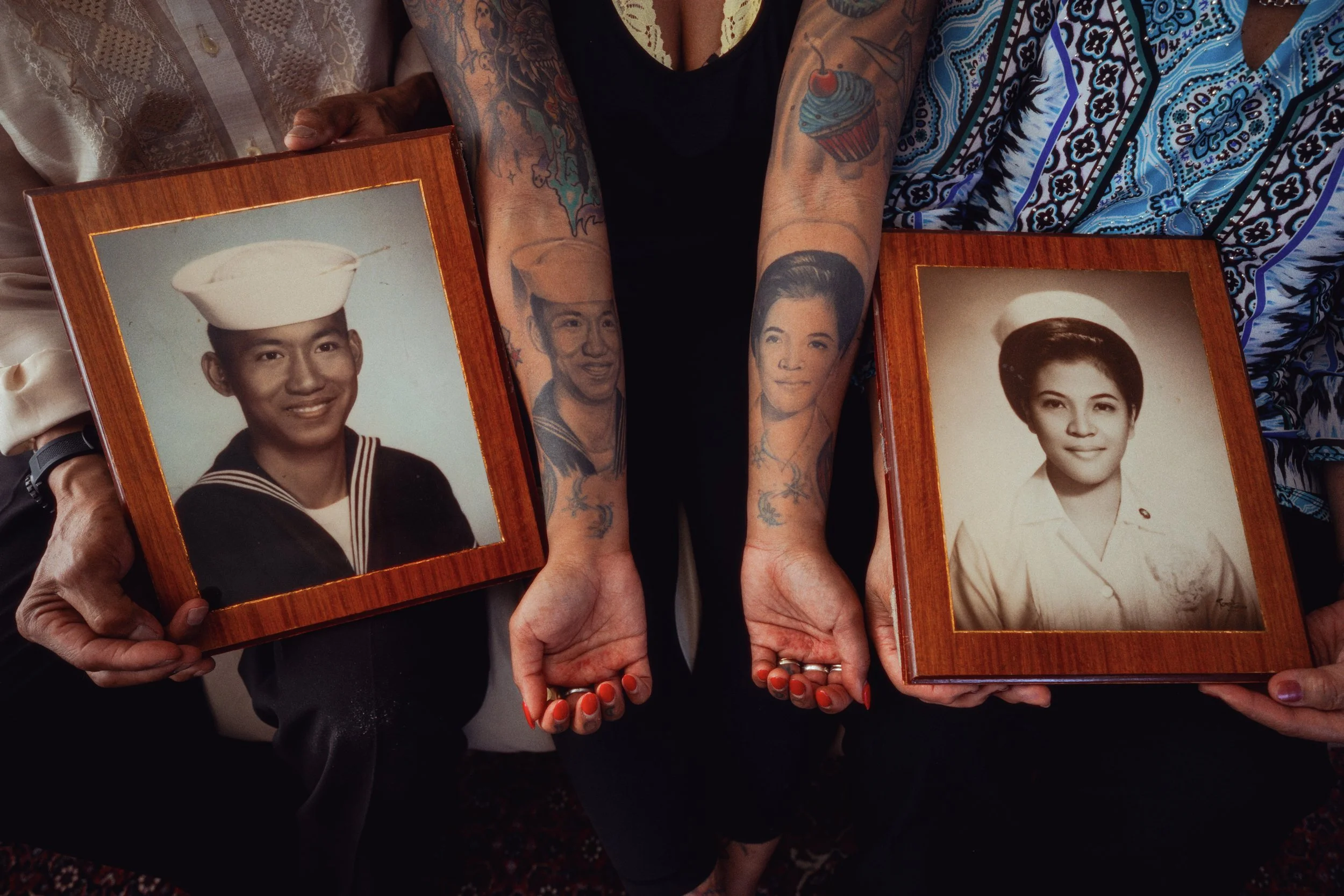
Danny (left) and Vicky Villanueva (right) hold portraits of themselves from around the time they began exchanging letters. Their daughter, Aims (center), shows off her tattoos of her parents’ portraits. (Photo by Joshua Albeza Branstetter)
A love story for the ages. That’s one way to sum up the story of Vicky and Danny Villanueva.
It all started in 1969, when Danny — serving in the Vietnam War with the U.S. Coast Guard — chose Vicky’s name off of a list of pen pals sent to his ship. Vicky, a nursing student at the time, added her name to the list after her classmate asked her to send it in.
“Then after a month, or a few weeks, I received a letter from him, and that’s how we started,” Vicky said.
Vicky and Danny communicated via letters and postcards for four years; they never met in person.
“Going home was expensive,” Danny said. “At that time, you couldn’t afford [to] fly just to see your girlfriend.”
After Vietnam, Danny worked on Sand Island in Honolulu, Hawai`i. He was the only bachelor in his unit, and it was then that he first had the thought that he wanted to marry Vicky. He wrote to Vicky and told her that he would start the process to petition her to emigrate so that they could get married in Hawai`i.
“But the family said, ‘no, you have to come home if you want to marry my daughter,” Danny said. “So that’s what I did.”
After four years of letters back-and-forth, Danny and Vicky finally met in person. Danny, who is originally from Baguio, a city in the mountainous Cordillera Region of the Philippines, traveled more than 80 miles east with his parents to meet Vicky’s family in Solano, Nueva Vizcaya. In Filipino culture, this is called pamanhikan, when the groom’s family asks permission from the bride’s family for the bride’s hand in marriage.
“My parents went to visit her parents and said, ‘our kids like each other, so let’s do it,’” Danny laughed.
“It’s really a different love story,” Vicky added.
They married in February 1973, and Vicky arrived in the United States a few months later in April. The two lived in Honolulu until 1978. They welcomed their first two children in Hawai`i, where Vicky worked part-time as a certified nursing assistant. Danny was transferred to San Francisco for a few years and was then assigned to Juneau in 1980.
“When we came here, we took the Malaspina ferry and we stayed at the Driftwood Hotel because we don’t have any military housing here,” Vicky said. “We tried to apply, but it took us a while. It was really hard in those years; there weren’t much houses for sale or for rent.”
Vicky says Juneau wasn’t what she thought Alaska would be. She didn’t expect to see mountains full of trees, and didn’t know about Juneau’s type of rain. She and Danny, along with their two kids, stayed at the hotel for a month before moving into a mobile home they bought from another Coast Guard family.
Vicky got a job at what was then Bartlett Memorial Hospital, which became Barlett Regional. She helped deliver babies at the hospital, including her daughter’s future husband. After retiring from the Coast Guard in 1987, Danny worked at the postal service until 2011. In 2004, Vicky retired to take care of her mother and sister, who arrived a couple years after Vicky and Danny settled in Juneau.
Vicky and Danny grew their family in Juneau, welcoming two more children in the 1980s and, later, grandchildren. They’ve spent the majority of their marriage in Alaska, and have fond memories of their family, like teaching their grandkids how to roll lumpia and cook Filipino dishes like adobo. They are especially proud of their children, and it’s the everyday moments with family — gathering around food and filling their home with warmth and laughter — that they want to keep alive for their grandkids and generations to come.
“I want them to continue our Filipino traits, some customs, maybe that we imparted to them while we are still alive,” Vicky said. “To love each other.”