Nita Coronell
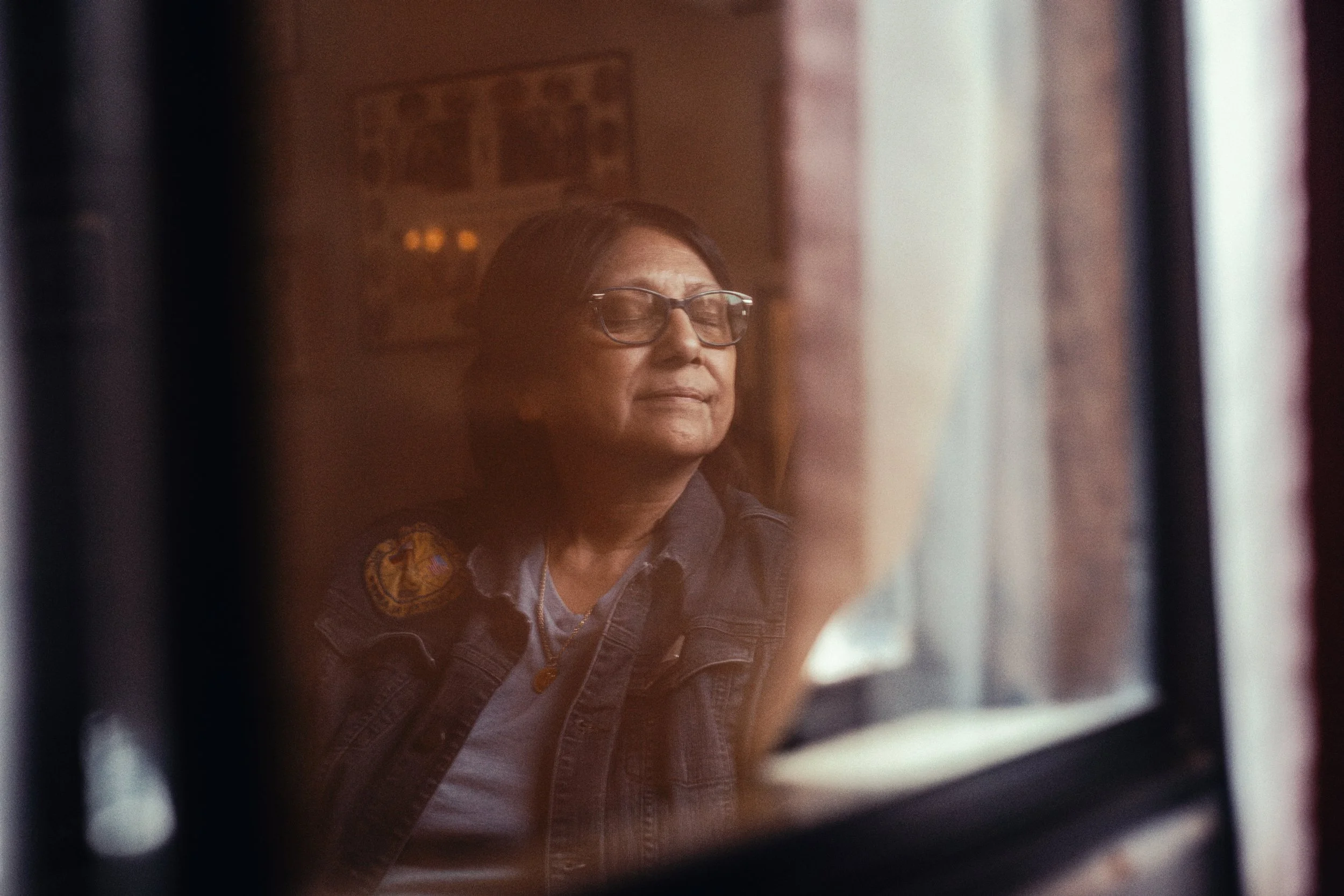
Nita Coronell at her home in Juneau, Alaska. (Photo by Joshua Albeza Branstetter)
Nita Coronell still remembers when she was small enough to prop herself up on the pool table at the old Filipino Hall. Every weekend, her father, Sam Coronell, took her to the hall where the men played rummy, strummed guitar and cooked together.
“I went everywhere he went when I was little,” she said. “He really didn’t have a choice because I’d just follow him.”
Sam was originally from Danao, Philippines. He left the Philippines when he was 16, as a stow away on a cargo ship to Hawai`i. He found work on the plantations and then made his way to the mainland, landing in California in the 1930s during the Great Depression. At that time, Filipino migrant workers traveled up and down the West Coast for seasonal work. Sam heard about Filipinos working further north in Alaska and he started boxing to earn money to make his way north.
“He had to fight in alleyways because it was the Depression days,” Nita said. “His fists got really big from fighting to make money.”
Sam was eventually recruited to work at a cannery in Petersburg. He went to Juneau in 1953 and met Nita’s mother, Dorothy, while playing guitar on the docks. Dorothy was only 18 at the time, and came from a strict, traditional Tlingit family. Sam was much older, and Dorothy’s parents forbid any relationship. It wasn’t until Dorothy’s father passed away that her mother allowed her to be with Sam.
Before they married, Sam had a son, Sam Jr., and Dorothy had a daughter, Lillian, each from a previous relationship. Together, Sam and Dorothy had six children: Nita and her five brothers Chris, Ben, Frank, Ray and Joe. Out of her siblings, Nita says she became most involved in the Filipino community.
“My brothers got the Tlingit blood; I'm the only one that came and got the Filipino blood,” Nita said with a laugh.
She says her desire to be involved came through her bond with her dad, who paid close attention to her as his only biological daughter. But she is proud of both sides of her heritage.
The Coronells were one of the mestizo families of Juneau, families of mixed Filipino and Tlingit heritage. There weren’t many spaces mestizo families felt welcomed. Though, Nita says she hadn’t understood what prejudice was until seventh grade, when friends in Douglas warned her that their parents “didn’t like Indians.” She also remembers visiting the cannery in Excursion Inlet with her mother and seeing how the bunkhouses were divided by ethnicity: Tlingit, Filipino, white and Japanese workers all kept apart.
“By the time I came around, I pretty much got along with everybody,” she said.
Nita was strong-willed from an early age. She started working at 12 years old through a “rent-a-kid” program. She cleaned behind restaurants downtown for a dollar an hour. When she was 14, she worked for Parks and Recreation and led camping trips to Glacier Bay.
She left Juneau in 1984 for auto mechanic training at a vocational school in Tacoma, Washington. Years later, she worked as a union laborer. She built concrete girders for overpasses in Anchorage and worked on the Exxon Valdez cleanup. She went back to Washington for a few years in the early 1990s. In 1991, she was on the I-90 and got hit by a semitruck. She had a long recovery after the accident and used a cane to get around.
The accident was part of the reason she returned to Juneau in 1994. That year at the Fourth of July parade, she heard Filipino drummers from a distance. The drumming reminded her of her father, who died six years earlier on her 30th birthday.
“As soon as they came up to me, and they all marched by me, the hairs on my arm stood up,” she said. “I just felt real close to my dad.”
She became involved with the Filipino community, joining as a dancer for two years and then moving on to drumming in 1998. She organized the community’s annual picnic, called bingo for the Filipino Community Hall for years, and helped start Mestizo Night, where Tlingit-Filipino families bring their own versions of Filipino dishes, particularly adobo. As she gets older, her father’s influence persists.
“From the years I did get to grow up with him, I just knew I had to be involved with the Filipino community to keep his name up,” she said.
These days, Nita is raising her great-niece and great-nephew the way her father raised her — with reverence for elders and to look out for one another.
At each Fourth of July Parade, Nita is the last drummer at the end of the drumming line.
“I’m the caboose,” she said. “I keep the herd together.”