
Juliet Suson Schmidt
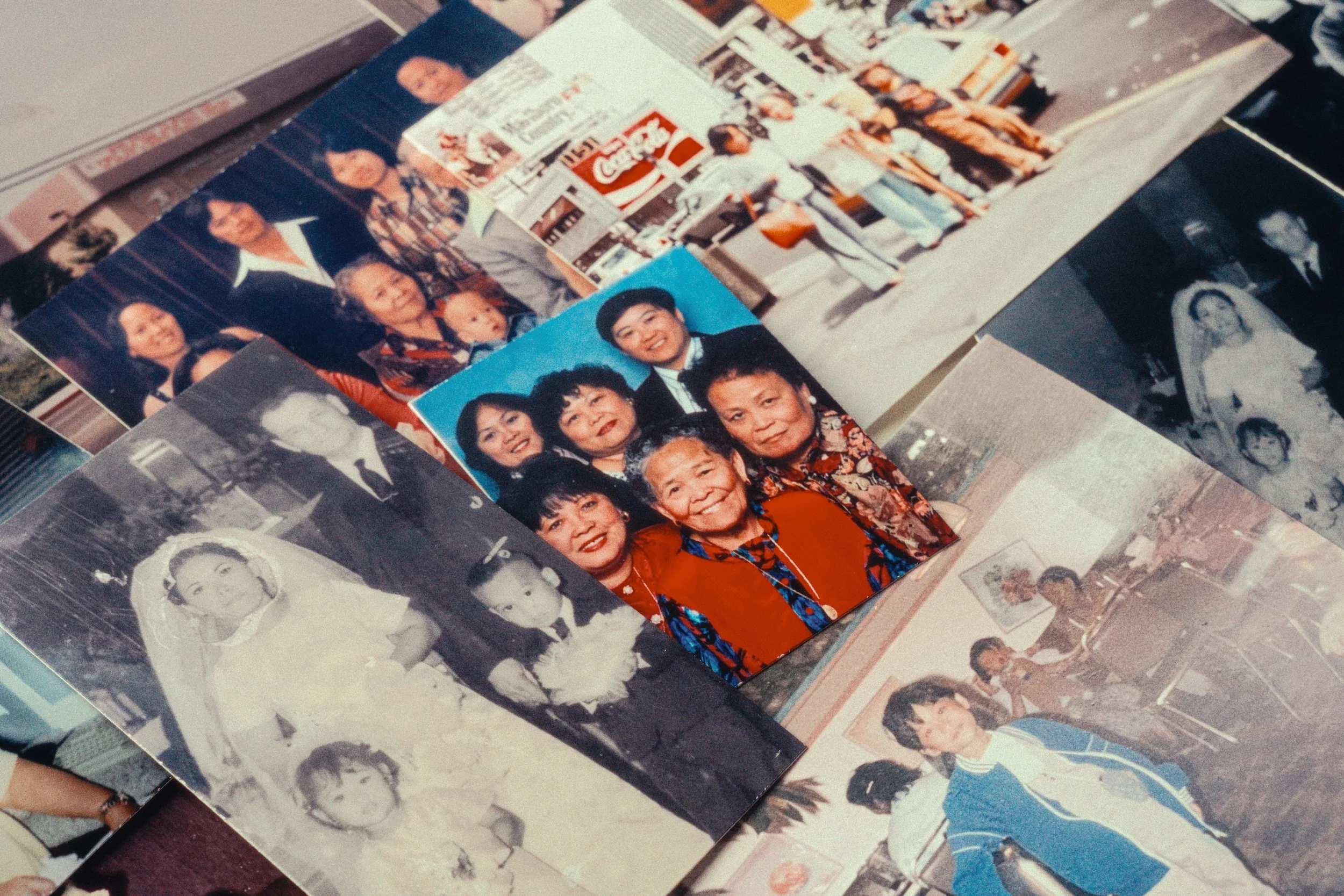
A collage of photographs from Juliet Suson’s Schmidt’s memories in the Philippines and Juneau, Alaska. (Photo by Joshua Albeza Branstetter)
Juliet Suson Schmidt is the reason that nearly her entire family — including her siblings, nieces, nephews, and their children and grandchildren — calls Alaska home.
Schmidt grew up in a large family in Cebu City, Philippines. She was the second among seven children and often witnessed her mother working hard to provide for their family, a responsibility she carried, too.
At 15 years old, Juliet Suson Schmidt began working to support her family. Schmidt spent mornings selling bread for a local bakery, hauling loaves of bread through the market before sunrise. By the time she was 20, she moved to a larger commercial bakery near Cebu’s public market, weaving through the stalls until nighttime, with trays of pandesal and sweet rolls.
Later, Schmidt’s aunt and uncle opened a beauty salon. Seeing an opportunity to provide more for her family, she asked if she could have a job. Her family said she’d need a diploma before she could work, so Schmidt trained at a cosmetology school and learned makeup and nail care. She became known for services such as makeup, manicures and pedicures. She worked at the parlor with her sister, Minda, but jokes she worked harder than her.
“I’m the only one,” she said. “Nobody’s helping me, because this one here (Minda) is too lazy.”
Schmidt’s reputation at the parlor grew quickly, allowing her to earn more money to support her family. She booked weddings, other special events and provided services to cruise ship visitors at Cebu harbor. Even with her busy schedule, she made time to stop at a bakery on her way home so she could greet her family with bags of fresh bread before dawn. Schmidt says there were “too many kids in the house,” and that food was not always regular for them.
“Wake up, I have the bread!” She remembers telling the kids each morning so they could eat.
In her late 20s, she became pen pals with Charles Schmidt, an American. A friend of Juliet’s wrote letters to Charles on her behalf because Juliet did not speak or understand English very well. Ten months after they began exchanging letters, Charles went to the Philippines to marry Juliet. She was hesitant to marry him because he was older and it was difficult for them to communicate — with a language barrier and Charles being deaf and mute. But Juliet carried on, because she saw the marriage with Charles, who’d been supporting her from afar, as another opportunity to help her family.
Charles and Juliet married in 1970, and Charles returned to the United States and began the process to bring Juliet to Juneau. In March 1971, they flew to Juneau, while Juliet was pregnant with their first son. The move hit Juliet hard.
“I was crying because it was really cold. I’m not happy here. I want to go back to the Philippines,” she said.
In the U.S., she worked hard and earned her GED. With her husband’s disabilities, she was the only one who could work. She heard about a job opening at the post office and, unsure about whether she would be hired, spoke with the postmaster directly.
“The postmaster at the post office was Larry Jackson,” she said. “I asked, ‘Good afternoon, sir. I hear you have an opening. Do you think you can hire me because my husband is a deaf mute? I’m the only one working to find a job for my son. ’”
The postmaster hired her and she remembers having to learn the responsibilities of the position quickly. She was put in charge of book mailing.
“He said, ‘I give you one week to learn,’” she recalled.
The position at the post office gave her steady employment as she supported her son, adjusted to life in the United States and continued to send money to her family back in the Philippines. She worked at the post office for 31 years
Even while working and living in the U.S., Schmidt stayed connected to her Filipino heritage. She valued family gatherings and traditions, ensuring that cultural practices continued. Family and spending time together are important to her.
During her early years in Juneau, Schmidt said she missed her family in the Philippines and tried to stay in contact with them by calling whenever she could. Over time, she worked to reunite with them and helped bring members of her family from the Philippines to the United States. She carried a responsibility many Filipino workers in Alaska still carry — often quietly and on their own — long hours, distance from home, and the challenge of adjusting to an unfamiliar place, all with the hope that one day their families would have an easier life. For Juliet Suson Schmidt, that hope eventually became reality.