Morris Carrillo
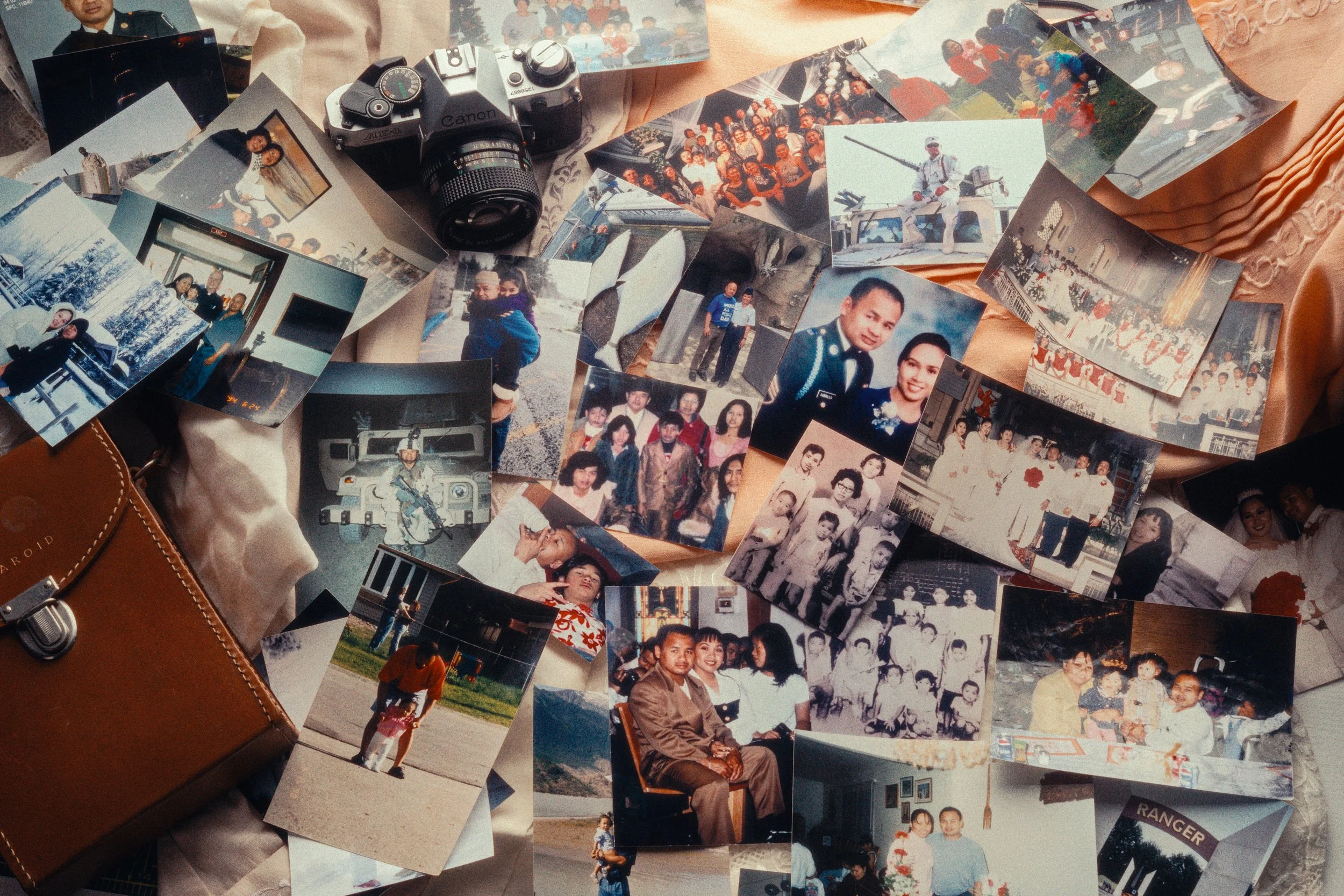
Photographs from Morris Carrillo’s personal collection, showing his life in Juneau, military career and family. (Photo by Joshua Albeza Branstetter)
Morris Carrillo arrived in Juneau at 14 years old in 1975 to an unfamiliar climate.
“In those days, in those months I mean, snow, it’s like crazy,” he said of his first impressions of Alaska’s capital city.
While he arrived in a place new to him, his transition from the Philippines to Alaska was made easier by the large extension of his relatives who had already been rooted in Juneau. Morris’ arrival represented the continuation of his family’s migration story that began nearly a half-century prior. His father, Alex Carrillo Sr., was part of an early generation of Filipino migrant workers.
Alex arrived in the United States in 1927. He was a farmworker before he made his way to Alaska as an Alaskero. He initially intended to go to Alaska to work in the canneries, but his trip up north changed course when the ship he was on, bound for Dutch Harbor in Unalaska, struck a rock and sank. Alex ended up staying in Juneau instead and worked at the AJ Gold Mine up until World War II.
Morris says his father was drafted into the U.S. Army. Alex served in the Philippines and returned to the U.S. after the war, and in the 1950s, he went home again to the Philippines where he married Morris’ mother and had six children.
By the late 1960s, according to Morris, Alex made the decision to move his family to the United States for better economic opportunities.
“It was probably better for his family to be here in the United States,” Morris said about his dad’s decision to resume the immigration process.
Alex brought his children one-by-one, and by the time Morris arrived in the mid-1970s, Juneau was evolving.
“There were no stop lights before when I first came here, not a single one,” Morris reminisced. “The Safeway, all of that, did not exist.”
In his first three years in Juneau, Morris lived in an upstairs apartment at the Filipino Community Hall on South Franklin Street. He says the hall felt like home, reminding him of his upbringing in the Philippines where he often spent time with elders. For Morris, the hall was more than a place he could stay to transition to life in Juneau. It was a place where he could learn about the history of the community he was now part of.
“I’m grateful to be able to hang out with [the elders], get to know them, and they were able to talk about my dad, share about my dad,” he said.
The Filipino Community Hall was and continues to be a centerpoint for Morris’ life. He remembers the liveliness in the building when community members, most of whom were his family, would gather to welcome newcomers to Juneau. He speaks of those days with nostalgia, remembering the sense of familiarity between Filipinos even in the most casual encounters.
“When we see each other at the store, we feel like home. We feel like we’re in the Philippines, and that was something I miss,” he says.
But Morris is honest, too, about the changes the hall and the community within it have faced over the years. The larger and faster that the city’s Filipino population grew, the less that the hall was able to keep up with the welcome parties. Yet, he says, the Filipino community persists to uphold traditions rooted in hospitality and collective effort.
Perhaps his most significant contributions to the Filipino community came through his presidency of Filipino Community Inc. during the early 2000s. Though Morris doesn’t take credit for the foundation of the project, it was during his term that Manila Square, featuring a bust of Philippine national hero Jose Rizal, was dedicated. Today, the square stands as a visible symbol of the Filipino community’s longstanding presence in Juneau.
Also during his leadership, he, along with his best friend Ellery Lumbab, co-founded Alitaptap, a dance troupe that performed traditional cultural dances of the Philippines from the pre- and post-colonial periods. Formed in 2002, the group had their first show the following year, and became a major focal point of Filipino culture in Juneau and throughout the state. Dancers of all ages, from children to elders, joined. At its peak, there were nearly 100 performers who took part in Alitaptap. The group traveled all throughout the state to perform in Anchorage, Fairbanks and other communities.
Alitaptap became inactive in 2004 after Morris was deployed to Iraq. Alitaptap continues to be a key chapter in the history of Filipino arts and culture within the community, and there are efforts to revive the group.
In the spirit of mana, Morris hopes the Filipino Community Hall, the traditions within it and history behind it, get passed down to the next generation.
“Mana is to inherit something,” he said, reflecting on the importance of the Filipino Community Hall. “Pinagmana natin ito from them (we inherited this from them). They have given it to us, and we need to give it to the next generation, para sila rin ang magmana (so they can inherit something too).”